
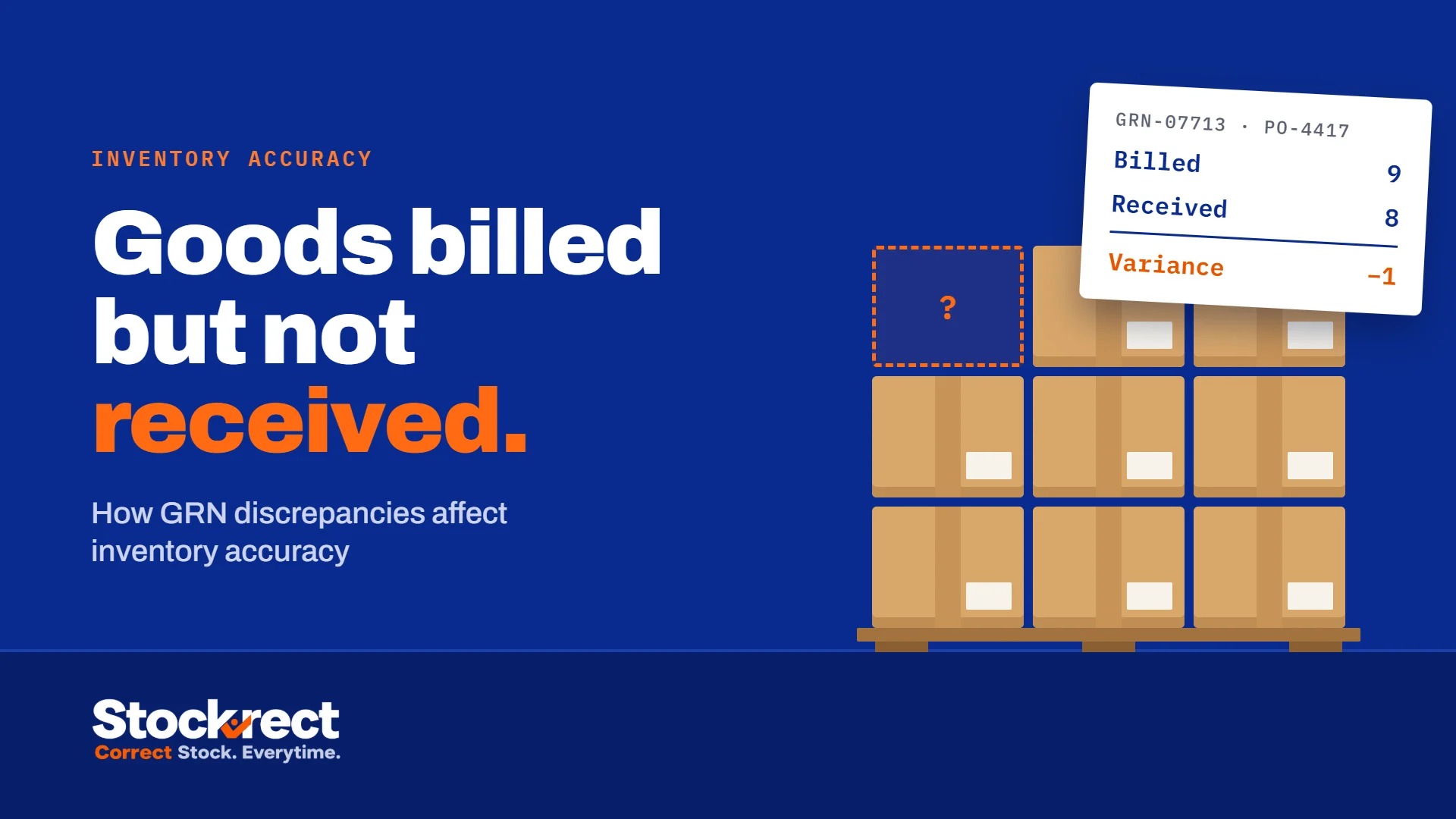
A supplier invoice shows 100 units delivered, but your warehouse receives only 92. If the receiving team records all 100 units without verifying the physical quantity, your inventory system immediately shows eight units that do not exist in the warehouse.
For distributors handling hundreds or thousands of SKUs, such discrepancies can lead to inaccurate stock availability, delayed orders, unnecessary purchases, and supplier disputes.
The rule is simple: record what was actually received, not merely what the supplier billed.
Why do GRN discrepancies occur?
A Goods Receipt Note (GRN) records goods received against a purchase order or other authorised reference, according to the company’s process. Discrepancies arise when the actual delivery differs from the expected or documented quantity, item or condition.
Common causes include:
- Short shipments: The supplier bills 100 units, but only 92 arrive.
- Incorrect items: The delivery contains a similar-looking SKU or the wrong product variant.
- Damaged goods: Some units arrive but cannot be accepted as usable stock.
- Pack-size errors: The supplier documents cartons while the warehouse records individual units incorrectly.
- Rushed receiving: Employees rely on delivery documents instead of verifying the goods.
- Delayed or incorrect entries: The receipt is recorded late, against the wrong purchase order or with an incorrect quantity.
In automotive spare-parts distribution, even a correct quantity can create a discrepancy if the wrong part number or vehicle variant is recorded.
What happens when the discrepancy is not handled correctly?
The impact extends beyond the receiving dock.
- Inaccurate stock availability: Employees may promise customers goods that are not physically available.
- Poor purchasing decisions: Incorrect balances can delay replenishment or trigger unnecessary orders.
- Supplier reconciliation issues: The invoice may show a quantity that the receiving records cannot support.
- Additional operational work: Warehouse, purchasing and accounts teams spend time investigating and correcting the difference.
For example, if 92 units arrive against an invoice for 100, the warehouse should record the verified receipt and document the eight-unit shortage. The purchasing or accounts team can then investigate whether a replacement, supplier credit, corrected invoice or another resolution is appropriate.
A correct GRN does not automatically resolve the supplier discrepancy. The shortage must also be tracked to closure.
Five controls to improve receiving accuracy
1. Verify the delivery physically. Compare the goods with the purchase order and delivery documents. Do not automatically copy the supplier’s billed quantity into the received quantity.
2. Confirm item identity. Check the SKU, part number, variant and unit of measure. Use barcode or QR identification where appropriate.
3. Record exceptions separately. Document shortages, excess quantities, damaged goods and rejected items according to the receiving procedure. Distinguish quantities received from quantities accepted into inventory where required.
4. Maintain supporting evidence. Link discrepancies to the relevant purchase order, delivery documents and receipt record. Retain photographs or other evidence where useful and permitted by the company’s procedures.
5. Assign responsibility for resolution. Track each discrepancy until the appropriate team confirms its outcome. Ensure accepted stock is recorded correctly and subsequent putaway movements are also captured.
GRN accuracy checklist
Before closing a receipt, ask:
Does the recorded quantity match what was physically verified?
Is the correct SKU and unit of measure recorded?
Are shortages, damage and other discrepancies documented?
Can purchasing and accounts trace the discrepancy to the relevant supplier documents?
Is responsibility assigned for follow-up and closure?
Will the accepted goods and their subsequent storage location be recorded correctly?
The takeaway
Inventory accuracy begins at receiving. If goods are recorded incorrectly at the point of entry, subsequent picking, replenishment and stock-counting processes may all be affected.
The objective is not simply to create a GRN. It is to establish an accurate receipt record, document exceptions and ensure that discrepancies are resolved.
Stockrect is being developed to support more disciplined inventory and warehouse operations. Businesses evaluating inventory-management technology should assess how well a solution supports their receiving, stock-recording and exception-handling processes.
For the broader picture, read our guide: Why Inventory Accuracy Breaks Down as Distributors Grow.